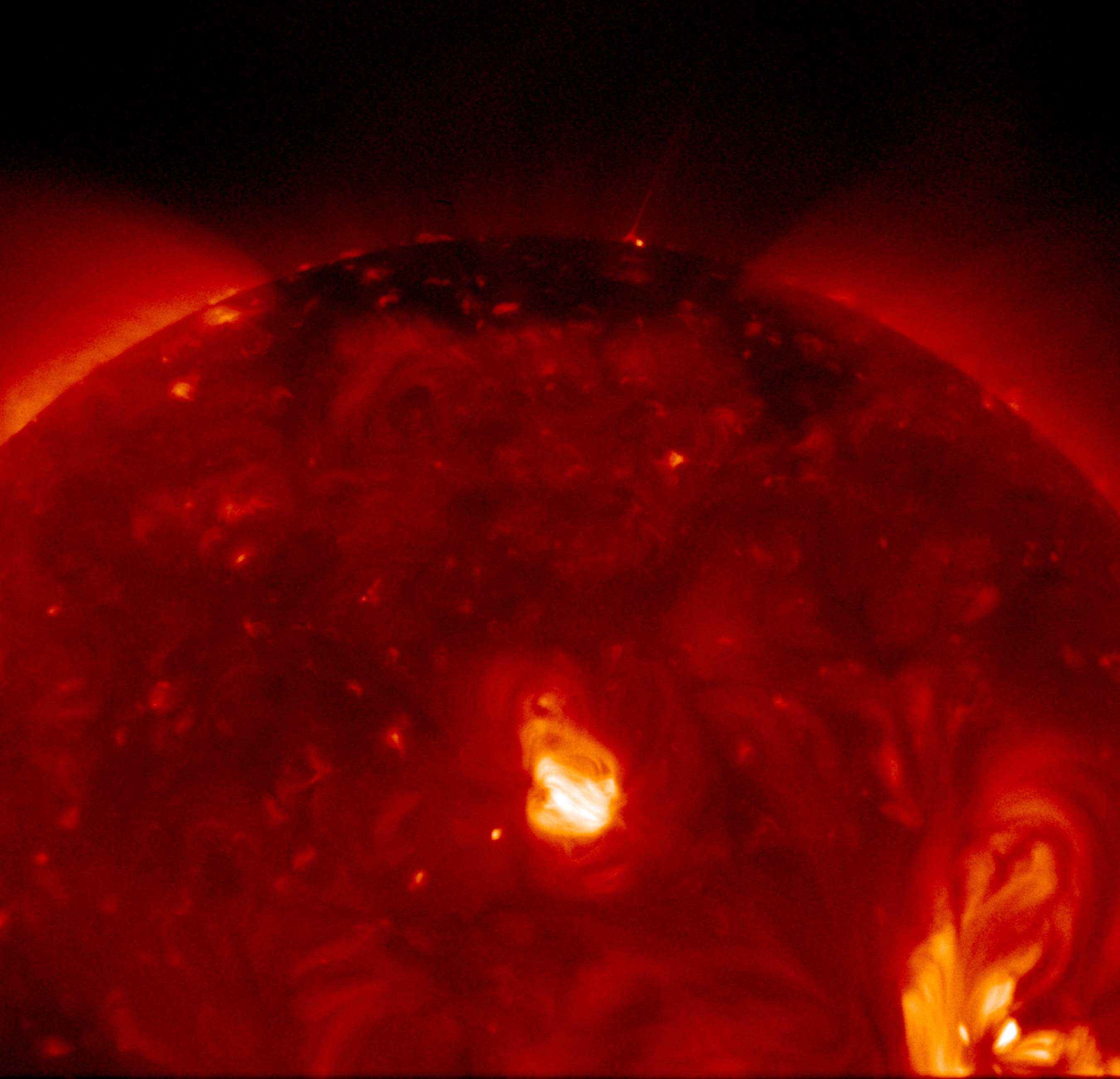
 Solar "Wind." A current of energy produced by our sun that is powerful enough to effect astronauts and satellites around earth. We don't fully understand what causes these winds, but it is believed that the suns magnetic field is at least partially responsible. This image, taken by the Japanese satellite Honide backs this hypothesis. 240 jets are captured in this photograph.
Friday, December 14, 2007
2.7 A Jet From the Sun... aka the KING!
Solar "Wind." A current of energy produced by our sun that is powerful enough to effect astronauts and satellites around earth. We don't fully understand what causes these winds, but it is believed that the suns magnetic field is at least partially responsible. This image, taken by the Japanese satellite Honide backs this hypothesis. 240 jets are captured in this photograph.

Friday, December 7, 2007
2.6 Mars Is Getting Larger.
Jay kay, jay kay, Mars isn't getting larger. It's just approaching opposition, on December 24th. However, due to Mar's highly elliptical approach, the date of closest approach will be on December 18th. (It will be "in" the constellation Gemini.) In this photograph, Syrtis Major is shown clearly. NASA has taken this relatively close proximity to land the Pheonix lander on Mars in 2008.
Friday, November 30, 2007
2.5-- Elephants on LSD. Droppin that acid. Oh yea. That's hot.
An iridescent cloud over Colorado. End of the world? Perhaps. But perhaps not. Actually- probably not. Iridescent clouds are formed of small water droplets of roughly the same size. The inner clouds greatly diffract sunlight in a coherent manner. (Or close to.) This happens most readily when the sun is behind thick clouds. Overall the phenomena is rare.
Friday, November 9, 2007
An X-Class Flare Region on the King.
This is a photograph of a flare unleashed by our sun, captured by the TRACE satellite- which filmed Active Region 9906. The event took place over about 4 hours. The gas flows around relatively stable magnetic fields, and reaches temperatures in excess of 10 million degrees Celsius. Many aspects of the processes are as of yet unknown.
Friday, November 2, 2007
2.02 Blizzog. For when Astronomy class just isn't enough.
October 31st. Halloween. Ghost-head Nebula. In this article; the people at NASA assume that the reader is interested in the past of Halloween. They were wrong. Halloween has been celebrated as a cross-quarter day-- a day halfway in between an equinox and a solstice. The Ghost-head Nebula looks like it's fictional counterpart and is a star forming region in the Large Magellanic Cloud. This nebula spans about 50 light years.
Friday, October 26, 2007
APOD 2.01-- It's the End of the World As We Know It....
And I feel fine.
In this "picture" the Universe's end is discussed-- the theory of the "Big Rip" is brought to the fore. (A mysterious repulsive phantom energy.) Too much dark matter in the universe will make the outward force from the Big Bang too massive to contain, and the universe will no longer be able to support itself. (Previous to this theory, the fate of the universe was centered on the theories of the Big Crunch or the Big Freeze.)
In this "picture" the Universe's end is discussed-- the theory of the "Big Rip" is brought to the fore. (A mysterious repulsive phantom energy.) Too much dark matter in the universe will make the outward force from the Big Bang too massive to contain, and the universe will no longer be able to support itself. (Previous to this theory, the fate of the universe was centered on the theories of the Big Crunch or the Big Freeze.)
Wednesday, October 17, 2007
Observation #1
8/20, 8/21
roughly 9:00 PM both days
Observed the moon and it's relative position to the 1st magnitude star Antares and the planet Jupiter. Noted how Jupiter and Antares position seemed to remain the same due to their extreme distance, while the moon seemed to be the only celestial body that was moving across the sky. Light pollution was minimal at my location, but it was somewhat cloudy.
Observation #2
Current phase of the year
early morning (roughly 6:30-6:45)
Noted specifically the constellation Orion each morning as I get up and head outside. (Assuming not a large amount of cloud cover. Light pollution is rarely a problem.) Also generally visible is Venus, which appears to be one of the brightest points in the sky at the time.
No instruments were used-- only the naked eye.
8/20, 8/21
roughly 9:00 PM both days
Observed the moon and it's relative position to the 1st magnitude star Antares and the planet Jupiter. Noted how Jupiter and Antares position seemed to remain the same due to their extreme distance, while the moon seemed to be the only celestial body that was moving across the sky. Light pollution was minimal at my location, but it was somewhat cloudy.
Observation #2
Current phase of the year
early morning (roughly 6:30-6:45)
Noted specifically the constellation Orion each morning as I get up and head outside. (Assuming not a large amount of cloud cover. Light pollution is rarely a problem.) Also generally visible is Venus, which appears to be one of the brightest points in the sky at the time.
No instruments were used-- only the naked eye.
Friday, October 12, 2007
Giovanni/Gian (Jean-Dominique) Domenico Cassini
Born on June 8, 1625- Cassini was an Italian-French Astronomer of enormous importance; one who established himself as an astrologer, an engineer, and an astronomer. Cassini was born in Perinaldo, which is known today as the Republic of Genoa. Early in life, Cassini was already showing interest in the cosmos; however it was not as an astronomer. Cassini started his career as an astrologer, (one who interprets information about celestial bodies in the hopes that the gleaned information would be practical in terrestrial affairs) which some theorize gave him a start in his eventual shift to astronomy. It should be noted that as Cassini aged, he moved so dramatically away from astrology that he denounced it completely, preferring to work solely on astronomy. Astrology however, is what landed Cassini his first job as an astronomer. In 1644, Cassini was invited to Bologna by its senator- Marquis Cornelio Malvasia to work in the Panzano Observatory which he was having constructed. He spent 21 years there- (1648-1669) until the King Louis XIV of France sent Cassini a grant to come head the then under construction Observatory of Paris, which would open in 1671. While in France, Cassini became a French citizen (and interestingly embraced France so warmly that he became known as Jean-Dominique Cassini) and worked with the opulent Louis XIV as his court astrologer/astronomer. While he fulfilled all aspects of his obligations to the king, he spent the vast majority of his time on astronomy. Some major highlights of his career include the discovery of the Cassini Divide, (a gap between rings A and B of Saturn) the Discovery of the Great Red Spot on Jupiter. He was also responsible for the discovery of four of Saturn’s moons- which he named collectively: Sidera Lodoicea, or Louisian Stars. Today however, the moons are named individually; Iapetus (1671), Rhea (1672), Tethys (1684), and Dione (1684). Amazingly, Cassini is also responsible for giving us the first “accurate” measure of scale in our galaxy. By sending an assistant to French Guiana to make simultaneous observations of Mars—he was able to use parallax to determine the planet’s distance. In approximately 1690, Cassini noted differential rotation in Jupiter’s atmosphere. Giovanni Cassini had a huge impact on astronomy in his time, indeed his impact was profound enough to carry over to modern times.
1.07 ...Counting is hard?
Bright Planets, Crescent Moon: Couching Tiger, Hidden Dragon.
This high resolution photograph, taken by Jay Ouellet contains several planets (Venus and Saturn), as well as the crescent moon in a tiny 5 degree field. The photograph also contains the celestial bodies Regulus and Titan. Interestingly, "Earthshine" illuminates sections of the darkened mono that we normally would not be able to see. Not shown in this photograph-- Mars; described as "a brilliant red-diode" by Jay Ouellet.
This high resolution photograph, taken by Jay Ouellet contains several planets (Venus and Saturn), as well as the crescent moon in a tiny 5 degree field. The photograph also contains the celestial bodies Regulus and Titan. Interestingly, "Earthshine" illuminates sections of the darkened mono that we normally would not be able to see. Not shown in this photograph-- Mars; described as "a brilliant red-diode" by Jay Ouellet.
Friday, September 28, 2007
1.5 The King is Holey, Haha. Holey. Get it?
The king of the planets has a "hole." A coronal hole is actually a low density region extending far above the surface of the sun (king of the planets) that is known to produce the solar winds. Shown in false color, the picture is actually taken in extreme ultraviolet light by the EIT instrument based on the SOHO observatory.
Friday, September 21, 2007
1.4 Astronomy Blog-- "What did the 5 fingers, say to the face?"
A: SLAP!
In the picture, "To Fly-Free in Space", astronomer Bruce McCandless goes on an untethered space walk. At 100 meters from the space shuttle, McCandless was and is the man to go the farthest away from his shuttle while being untethered. He propelled himself with an MMU, which has since been replaced with a safer unit.
COMING THIS WEEKEND-- SPECIAL HALF BLOG ON ASTRONOMY OBSERVATIONS!!!
HOORAYYYY
Stay tuned.
In the picture, "To Fly-Free in Space", astronomer Bruce McCandless goes on an untethered space walk. At 100 meters from the space shuttle, McCandless was and is the man to go the farthest away from his shuttle while being untethered. He propelled himself with an MMU, which has since been replaced with a safer unit.
COMING THIS WEEKEND-- SPECIAL HALF BLOG ON ASTRONOMY OBSERVATIONS!!!
HOORAYYYY
Stay tuned.
Friday, September 14, 2007
Log 03; Bud Light "RMoG" Commercials are HILARIOUS
"The Voyager's Message in a Bottle."
When we launched Voyager, we included information to be used by any form of intelligent life that may happen across it. The information is stored on a gold-plated copper disk (phonograph), with saved audio and images that depict the cultures that may be found on Earth. The cover is engraved with instructions on the disks purpose, as well as how to play it.
When we launched Voyager, we included information to be used by any form of intelligent life that may happen across it. The information is stored on a gold-plated copper disk (phonograph), with saved audio and images that depict the cultures that may be found on Earth. The cover is engraved with instructions on the disks purpose, as well as how to play it.
Friday, September 7, 2007
Astro Log 1.2; I'm curious like a cat. That's why my friends call me whiskers.
What's inside the Victoria crater? Now that the dust storms of Mars have toned it down, we can find out. The picture outlines a "possibly traversable" pathway down into the crater, taken by the martian rover, "Opportunity."
As a side note, the crater is the largest either of the rovers have yet to come across. It is significant because scientists hope to use it's depth to further their understanding of the planet's composition.
As a side note, the crater is the largest either of the rovers have yet to come across. It is significant because scientists hope to use it's depth to further their understanding of the planet's composition.
Friday, August 31, 2007
Astro Log 01; Mad Cow Disease, or the Best Scientist in Your Field?
Gigantic Jets over Oklahoma
I picked this particular PotD because after watching it in class, I had a strong desire to figure out what I had seen. Upon originally hearing the moniker "Gigantic Jets", I assumed it was discussing man made aircraft. After some reading though, I learned that this phenomena is actually a rare form of electrical discharge. This is similar to the better known phenomena, blue-jets as well as upper-atmosphere/red sprites. (I assume this is the reference made in the video of "Carrot Sprites.")
I picked this particular PotD because after watching it in class, I had a strong desire to figure out what I had seen. Upon originally hearing the moniker "Gigantic Jets", I assumed it was discussing man made aircraft. After some reading though, I learned that this phenomena is actually a rare form of electrical discharge. This is similar to the better known phenomena, blue-jets as well as upper-atmosphere/red sprites. (I assume this is the reference made in the video of "Carrot Sprites.")
Subscribe to:
Posts (Atom)