
Edwin Hubble (wasn't a baddy!)
Physically able as a young man, he did well in all classes except for spelling (lol). He attended the University of Chicago and focused primarily on mathematics, astronomy and philosophy; receiving a BS degree in the year 1910. (Ended up in the Kappa Sigma fraternity, and in 1948 was awarded the title Kappa Sigma Man of the Year.)
He then went on to spend time at Oxford as one of the first Rhodes scholars, and while there focused attention on studying Jurisprudence, but eventually transferring to Spanish, receiving a Master of Arts degree. It was this period of time that he picked up his English/poser attitudes and habits, which remained with him throughout his life.
From this point in time, several things in his life occurred that kept him out of astronomy- he taught and coached basketball at a high school in Indiana - New Albany High School. He also was registered withe the Kentucky Bar, however he did not spend long in the field of law before serving in WWI, where he earned the rank of major. After the war, he returned to the University of Chicago to earn is PhD in Astronomy in 1917, while working at the Yerkes Observatory. (Interestingly, his dissertation was- "Photographic Investigations of Faint Nebulae".) Two years later, Hubble was offered a job at the Mount Wilson Observatory by George Ellory Hale. (wooooo!) It was here and at the US Army Aberdeen Proving Ground (Palomar) that Hubble remained working at until his death. [Also important to note that Hubble received the Legion of Merit for his work at Palomar.]
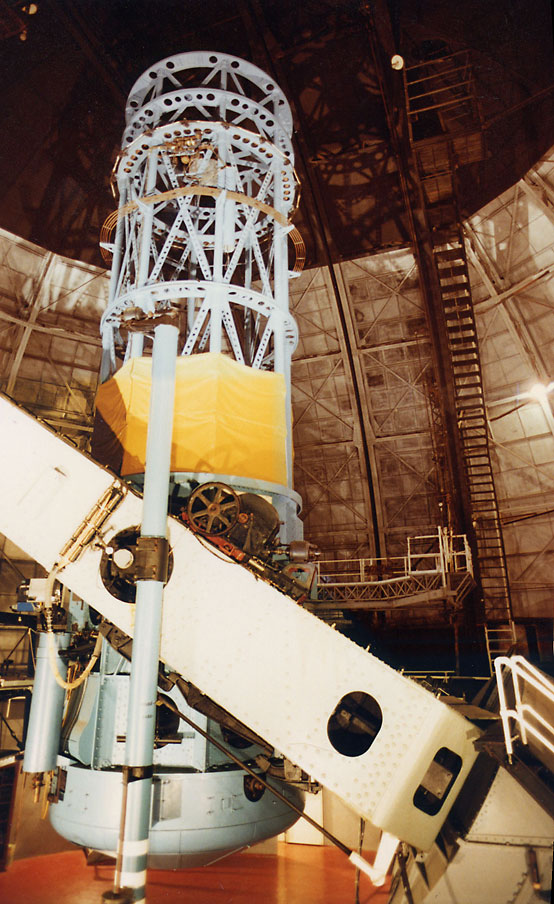
Hubble's arrival at Mount Wilson was roughly in sync with the completion of the Hooker Telescope (shown at the top right of the page, because this website sucks and won't put pictures in the body of text apparently!)- aforementioned in George Ellery Hale's name. Using this 100 inch reflecting telescope- Hubble captured and studied Cepheid Variables/Standard Candle stars- noting their are galaxies outside our own.
It is not surprising then that he should develop a system of classification for these newfound galaxies- and he did just that. Known to us today as Hubble's Tuning Fork/Hubble Sequence, it classified galaxies by size, shape, color, and brightness. It was at this point in time that he noted the redshift phenomenon, Hubble's Law. It is important to note that Hubble's Many Galaxy thought process was strongly opposed by the scientific community -(damn you, Shapley!) never fear, however! His further observations proved conclusively in the early 1920s that the scale of the universe was far greater than we had previously imagined. (EAT IT, SHAPLEY! HA!)